Ouch! Making Sense of Your Frenchie Puppy's Biting Phase (Before It Gets Out of Hand)
If you've recently brought home a French Bulldog puppy, you've probably already discovered what we like to call the "Frenchie tax" — those little nips, chomps, and full-on ambushes on your ankles every time you walk past the couch. It stings. Literally. But before you start Googling "why does my dog hate me," take a breath. Biting is a completely natural part of puppy development, and your Frenchie isn't plotting your demise. Probably.
That said, there's a real difference between normal mouthy puppy behavior and patterns that need your attention sooner rather than later. Let's break it all down so you know exactly what you're dealing with.
Why Puppies Bite in the First Place
Here's the thing — puppies explore the world with their mouths. It's how they figure out textures, test boundaries, and communicate with the world around them. Before they came home with you, they were wrestling with their littermates, using their teeth to play, signal discomfort, or just burn off energy. It's completely instinctive.
For French Bulldogs specifically, that natural mouthy tendency gets layered on top of a breed that's already energetic, curious, and a little theatrical. Frenchies are expressive dogs. When they're excited, they go all in — and sometimes that excitement comes out through their teeth.
Add teething into the mix, and you've got yourself a certified chomping machine.
The Teething Timeline: What to Expect and When
Puppies go through two distinct teething phases, and both of them can ramp up the biting behavior significantly.
Phase one happens around 3 to 4 weeks old — way before your pup ever comes home with you. This is when their baby teeth (also called deciduous teeth) start coming in. By the time you pick up your Frenchie at around 8 weeks, they've got a full set of those tiny, needle-sharp milk teeth.
Phase two is the one you'll actually live through. Starting around 3 to 4 months and running until about 6 to 7 months, your puppy's adult teeth start pushing through. This process is uncomfortable — sometimes genuinely painful — and chewing provides relief. During this window, don't be surprised if the biting frequency spikes. Your pup isn't being bad. Their gums are sore, and gnawing feels good.
Once all 42 adult teeth are in, the intensity usually drops off on its own. But that doesn't mean you should just white-knuckle it until then. You can — and should — be actively shaping this behavior the whole time.
Play Biting vs. Aggressive Biting: Knowing the Difference
This is where a lot of new owners get confused, and honestly, the confusion is understandable. Both look like biting. But they're coming from very different places.
Play biting is usually loose, bouncy, and comes with a wiggly body and relaxed posture. Your Frenchie is zooming around, gets excited, and their mouth just... finds your hand. They're not angry. They're having the time of their life. The bites might be hard (puppies have zero bite inhibition at first), but the energy behind them is playful.
Aggressive biting looks and feels different. Watch for a stiff body, a hard stare, growling that sounds low and serious rather than playful, or snapping that happens in response to something specific — like you reaching for their food bowl or picking them up when they don't want to be touched. This kind of biting is communicating something: fear, discomfort, resource guarding, or pain.
If you're seeing consistent signs of the second type, especially in a very young puppy, that's worth a conversation with your vet or a certified dog trainer. It doesn't mean your Frenchie is broken — it just means something needs to be addressed before it becomes a bigger habit.
Techniques That Actually Work to Redirect the Biting
Good news: most Frenchie puppies respond really well to consistent redirection. Here's what tends to work.
Yelp and pause. When your pup bites down too hard, make a short, sharp yelp (think: surprised, not angry) and immediately stop all interaction. Freeze. Go boring. This mimics what a littermate would do — and it signals that biting too hard ends the fun. Resume play after a few seconds. Repeat every single time.
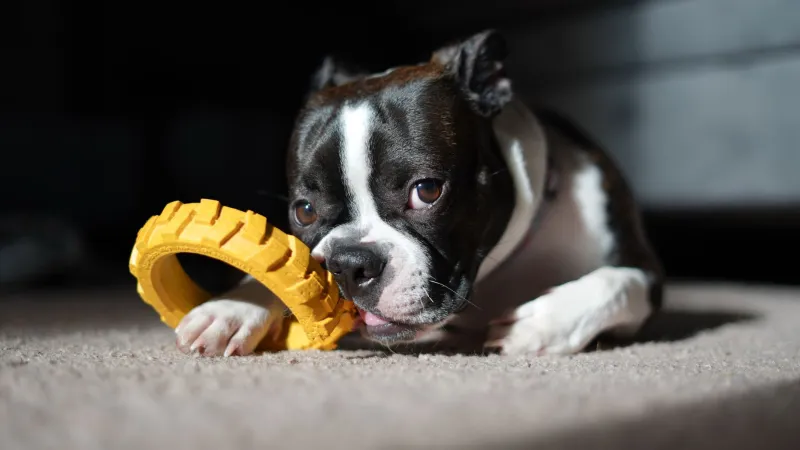
Redirect to a toy. Keep appropriate chew toys within arm's reach at all times during peak zoomie hours. The moment teeth make contact with skin, calmly swap your hand out for a toy. Don't yank your hand away dramatically — that can accidentally make it more exciting. Just smoothly replace yourself with something chewable and appropriate.
Time-outs work. If the yelp-and-pause isn't landing, a brief time-out in a calm space (a pen or crate they're already comfortable with) can help. Keep it short — 30 to 60 seconds is enough to interrupt the energy spiral. The point isn't punishment; it's giving them a chance to reset.
Freeze-dried treats for calm behavior. Positive reinforcement goes a long way here. When your Frenchie is engaging with you without biting — playing with a toy, sitting near you, offering a paw — mark it and reward it. You're building a new pattern: calm interaction = good things happen.
Tire them out before training sessions. A Frenchie who's already burned some energy is way easier to work with than one who's been cooped up all day. A short walk or a play session before you work on bite training makes a real difference.
When It's Time to Call In Backup
Most French Bulldog puppies cruise through the biting phase and come out the other side as perfectly polite little companions. But there are situations where you shouldn't try to handle it solo.
If your puppy is biting hard enough to break skin regularly, if they're guarding food or objects with real intensity, or if you're noticing fear-based biting responses even in calm situations — get a professional involved. A certified professional dog trainer (look for a CPDT-KA credential) or your vet can help you figure out what's driving the behavior and give you a plan that's specific to your pup.
There's no shame in asking for help. Frenchies are smart, stubborn, and opinionated little creatures. Sometimes they need a little extra guidance, and so do we.
Hang In There — It Does Get Better
The biting phase can feel endless when you're in the middle of it, especially when you're walking around with little teeth marks on your hands like some kind of puppy-themed hazard zone. But here's the truth: it passes. With consistency, patience, and a good stash of chew toys, most Frenchie owners look back on this stage and laugh.
Your pup isn't being mean. They're being a puppy. And one day soon, that chompy little gremlin is going to fall asleep on your lap and you'll forget all about it.
Almost.