Stuck to You Like Velcro: The Real Reason Your Frenchie Can't Stand Being Two Feet Away
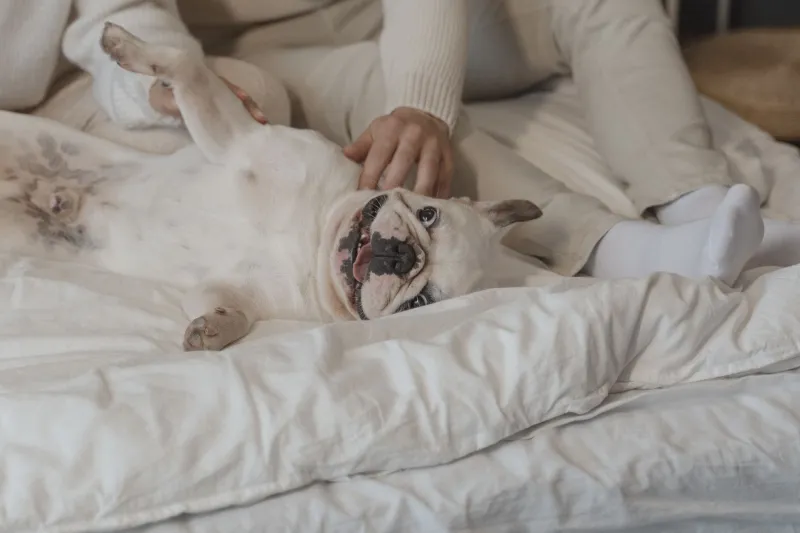
You got up to refill your coffee. Your Frenchie is now sitting on your feet. You moved to the couch. There they are. You closed the bathroom door for approximately ninety seconds and the scratching started. If this sounds like your daily reality, welcome to life with one of the most devoted, borderline obsessive companion dogs on the planet.
This isn't a quirk. It's not bad behavior (well, mostly). It's centuries of selective breeding doing exactly what it was designed to do — and once you understand that, managing it gets a whole lot easier.
A Dog Built for Your Lap, Not the Field
Unlike retrievers bred to work a field or hounds engineered to track game across miles of wilderness, the French Bulldog was developed with one job in mind: keep a human company. Their origins trace back to the lace workers of Nottingham, England, who brought small bulldogs along when they relocated to France during the Industrial Revolution. French city dwellers — particularly in Paris — fell hard for the breed, and over generations, those dogs were refined into the compact, bat-eared companion we know today.
The key word there is companion. Not working dog. Not sport dog. Companion. That distinction matters enormously when you're trying to figure out why your Frenchie acts like you disappearing into the garage is a five-alarm emergency.
These dogs weren't bred to operate independently. They were bred to be emotionally attuned to humans, physically close, and deeply invested in what you're doing. Every generation of selective breeding reinforced those traits. So when your Frenchie crawls into your lap uninvited and refuses to budge, they're not being difficult — they're being exactly what they were designed to be.
What the Clinginess Is Actually Telling You
Physical contact isn't just comfort for a French Bulldog — it's communication. When your pup presses their warm, dense little body against your leg or insists on sleeping with some part of themselves touching you, they're doing several things at once.
First, they're regulating. Frenchies, like many companion breeds, use proximity to manage stress. Your presence is genuinely calming to them on a physiological level. Second, they're bonding. Physical touch releases oxytocin in dogs just like it does in humans, reinforcing attachment. Third — and this one matters — they may be checking in because something feels uncertain. A dog that suddenly becomes extra clingy after a schedule change, a move, or a new addition to the household is often communicating low-grade anxiety.
That last one is worth paying attention to. Clinginess and separation anxiety aren't the same thing, but they exist on the same spectrum. A velcro pup who loses their mind the second you leave the house has crossed into territory that deserves some intentional attention.
When Adorable Becomes a Problem
Here's the hard truth: a dog that cannot tolerate being alone isn't just inconvenient — they're suffering. Separation anxiety in French Bulldogs can show up as destructive behavior, excessive barking or howling, house accidents despite being fully trained, and in more severe cases, self-harm behaviors like excessive licking or chewing.
If your Frenchie is glued to you 24/7 and you've never really worked on building their independence, you may be accidentally reinforcing a dependency that makes their world feel very small and very fragile. Every time they follow you and you immediately engage with them, every time you scoop them up the moment they whine, you're teaching them that distress = human attention. That's a loop worth interrupting.
Building a More Confident Frenchie (Without Crushing Their Spirit)
The goal isn't to turn your affectionate little gremlin into an aloof loner. That's not happening, and honestly, you'd miss the snuggles. The goal is to raise a dog who chooses to be with you rather than one who panics when they can't be.
Start with micro-separations. You don't need to leave the house to practice being apart. Close a door between you and your Frenchie for two minutes. Then five. Build up gradually so that "out of sight" stops feeling like "gone forever."
Teach a solid "place" command. Training your Frenchie to go to a specific bed or mat and stay there — even while you move around the house — gives them a job and a sense of structure. It also starts rewiring the idea that they have to be physically attached to feel secure.
Don't make arrivals and departures dramatic. This one's tough because Frenchies are so expressive that ignoring their greeting frenzy feels mean. But long, emotional goodbyes and enthusiastic homecomings actually amp up anxiety. Keep departures calm and low-key. Wait until your pup has settled before giving them attention when you return.
Give them a pre-departure routine. A Kong stuffed with peanut butter (xylitol-free, always), a puzzle toy, or a frozen treat can create a positive association with alone time. If good things happen when you leave, leaving becomes less catastrophic.
Exercise before alone time. A tired Frenchie is a calmer Frenchie. A solid walk or a play session before you head out gives them an outlet and makes rest feel more natural.
When to Call in Backup
If you've tried these strategies consistently and your Frenchie is still destructive, inconsolable, or showing signs of genuine distress when left alone, it's time to loop in a professional. A certified dog trainer or veterinary behaviorist can assess whether you're dealing with true separation anxiety and build a behavior modification plan tailored to your specific pup. In some cases, a vet conversation about anxiety support — whether that's supplements or short-term medication — may also be appropriate.
This isn't failure. It's just recognizing that some dogs need more structured help, and getting it for them is one of the most loving things you can do.
The Snuggle Struggle Is Worth It
Here's the thing about Frenchies: their intensity of affection is also what makes them extraordinary companions. That dog who follows you everywhere, who sighs contentedly the second they're in contact with you, who looks at you like you personally hung the moon? That's not a bug. That's the whole point of the breed.
The work isn't about changing who your Frenchie is. It's about giving them the emotional tools to feel safe even when you're not in the same room — so that when you are together (which, let's be real, is most of the time), it's a choice rather than a compulsion.
And honestly? A Frenchie who chooses your lap out of love rather than panic is even sweeter than one who camps there out of anxiety. That's the snuggle worth working for.